


Growing Without Losing Yourself: Strengths, Saboteurs, and how to know if you are at the real edge of your development

One of the most common questions I hear in leadership coaching, both professional and personal, sounds like this:
“How do I grow without becoming someone I’m not?”
This question often emerges after people have begun to consider their strengths, clarify their values, and notice their patterns under pressure. They are connecting the dots and seeing the relationships and so the tension usually goes something like this:
If I lean into my strengths, I am just doing more of the same.
If I try to change, I risk losing what makes me effective.
And what I’ve come to understand, through reading research, my professional development, and lived experience, is that real growth doesn’t come from doubling down on or replacing our strengths.
It comes from expanding our capacity to hold what we are good at and lean into what stretches us, at the same time.

Let me explain.
Most of us have a fairly stable set of strengths. Some of mine include:
a genuine ability to like, respect, and pay attention to people
a capacity to see patterns and meaning and try them out across contexts
flexibility and an ability to pivot when conditions change
These strengths serve me well. Until I’m under pressure.
When the room gets too loud, hierarchical, or dominated by strong personalities, I try to cope by relying on my key strengths even more, and in doing so, in over-using them, my strengths lose their impact and their power and I begin to be more rigid and more reactive.
My attunement turns into pleasing.
My meaning-making turns into controlling.
My flexibility turns into disappearing or self-silencing.
Many frameworks call these Saboteurs. I have learned to not consider them as flaws but rather as my strengths under threat, protective strategies that once worked, and that still show up when something important is at stake. And the frustrating truth is: my Saboteurs/(strengths under threat) are often no longer useful to what I’m trying to achieve. In fact, while they may work in the short-term, they often undermine my long-term success.
The work isn’t to get rid of them. My work is to grow my capacity so that I don’t have to over-use my key strengths because I have other strengths that I can use, that actually may be more effective.

My natural style is an S (Steadiness) style, (green on the DiSC model above) relational, thoughtful, and people-centered. That’s not something I want to lose. It is one of my superpowers. But like every style, my S style has a learning edge. A place where I can get stuck.
Under pressure, especially with strong personalities, I can get caught in an internal belief:
If I push back too hard, I risk the relationship.
The question is not whether to “become more dominant” or “to stop caring about the relationship”.
The answer is that my real work is learning to continue to hold my ability to be warm, caring and relational and also lean into and learn to hold the strengths of assertiveness and clarity, when needed. While these strengths sit in other personality styles, they are also in me. I am just not as comfortable with them because they aren’t my innate, go-to strengths. But the more I practice using them, the easier they feel to use.
"Growth is uncomfortable because you've never been here before." — Susan David
For my style, development looks like learning to hold both:
warmth and authority
care and clarity
relationship and position
Not sequentially. Not strategically. Simultaneously and authentically.

This gives me increased range. Increased impact. Increased presence.
What This Looks Like in Real Life
Growth doesn’t happen through insight alone. It happens in very small, very specific moments.
For me, the learning edge shows up right before I am about to do what I usually do … I over-use my strength when I appease or please others, at my expense, and:
soften a bold statement
over-explain to be understood
wait for permission to act or
pivot away from my belief or position.
Doing it differently is subtle. Often only I know I’m doing something different. And only I know that it feels uncomfortable. My internal strengths under pressure (saboteur) voices are usually very loud at this point, reminding me that the old strategies are safer, more polite, more familiar. What they fail to mention is that they haven’t worked for years.
At my learning edge, a new practice can look like:
stating a position without pre-justifying
pausing after I speak instead of filling the space
staying present and holding my opinion while someone disagrees, or
letting the impact land without rescuing someone/anyone.
It is clearer, more direct … and nothing about this requires me to become less relational. Ironically, it requires me to be in better relation with myself and others, and then provides even more.

How You Know You’re Growing
Real stretch, real growth has a particular feel.
It’s not flashy. It’s often messy. It’s uncomfortable, and somehow, feels deeply right.
The internal markers I watch for are feeling more steady, less urgent. A reduced need to control. To manage others’ reactions. Having a quieter, firmer sense of me, comfortable with how I am showing up.
When I’m compensating, I feel somewhat armoured and tense.
When I’m growing and developing, I feel more grounded, balanced and open to moving forward, and it feels right for me. Because whose life is this anyway …

What This Looks Like for All DISC Styles
One of the reasons I find the Everything DiSC model so useful is that it makes one thing very clear:
Every style has a growth edge, and it’s always about accessing ‘the more’ that is already within you. It is never about becoming someone else.
For D (Dominance) styles
(red on DiSC model)
Your strengths include decisiveness, drive, courage, and clarity.
Under pressure, these can turn into impatience, bulldozing, insensitivity or control.
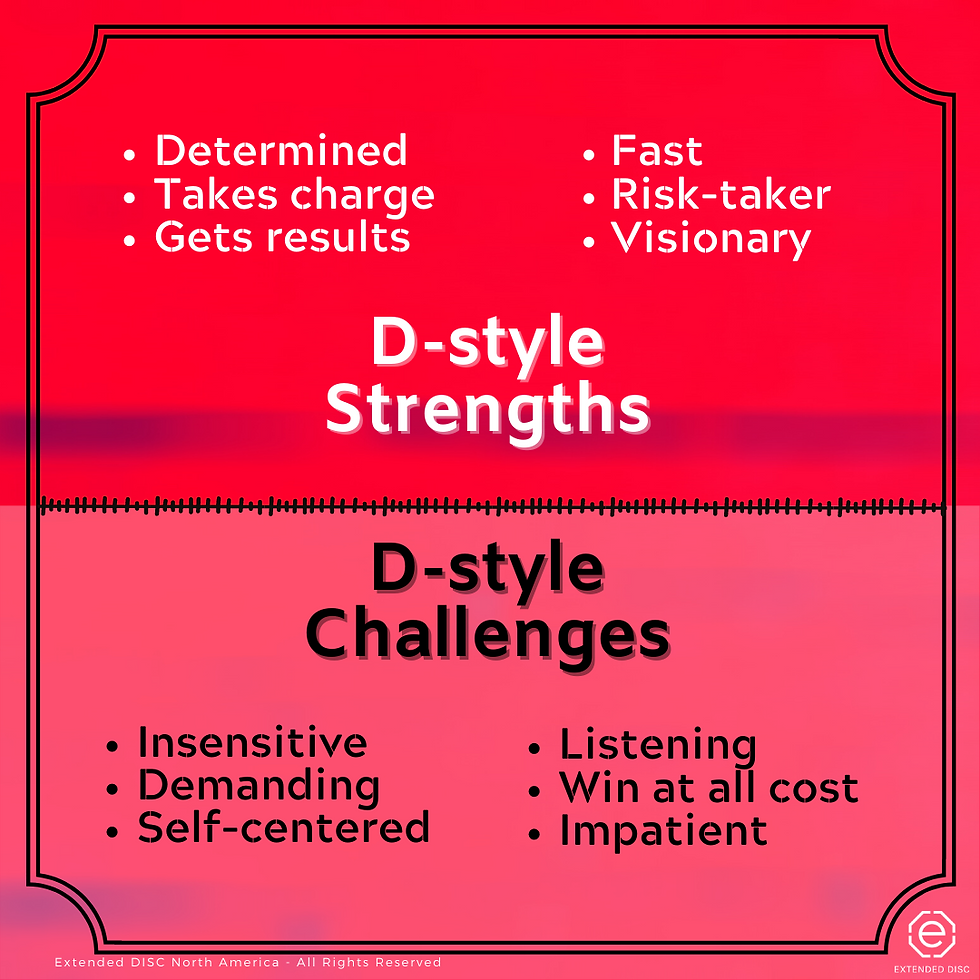
Your developmental edge is learning to hold empathy, and listen and see that you can care and still have momentum and still achieve results.
For you, growth often feels slow and inefficient but it is in that slowing down, that pause, where trust grows.

For I (Influence) styles
(yellow on DiSC model)
Your strengths include enthusiasm, vision, connection, and energy.
Under pressure, these can turn into over-talking, avoiding detail, impulsiveness or seeking approval.
Your developmental edge is often learning to hold structure, discipline, and follow-through without losing your energy and inspiration.
Growth can feel heavy at first, not because your creativity is lost, but because capacity is being built with the practice of these additional strengths.
For S (Steadiness) styles
(green on DiSC model)
Your strengths include calmness, collaboration, loyalty, and being a team player.
Under pressure, these can turn into being overly cautious, over-pleasing, or resisting change.


For C (Conscientious) styles
(blue on DiSC model)
Your strengths include rigor, depth, accuracy, and discernment.
Under pressure, these can turn into perfectionism, over-analysis, or withdrawal.
Your developmental edge is learning to hold decisiveness and connection without losing the thoroughness and quality you strive for.
Growth can feel premature and risky. My C clients hate being rushed to take action without enough info … and it is in the risk and the relationship where your leadership expands.
The Pattern That Unites All Styles
Across all our styles, the pattern is the same:
Our strengths don’t disappear under pressure, they become our Saboteurs, where using the strength comes at our expense. Development happens when we can hold what we’re good at and what we usually avoid, at the same time.
Growth isn’t correction ~ growth is capacity expansion. And like it or not, life offers us practice opportunities every day.

A Final Reflection
No matter your style, the developmental question is always some version of this:
Can I stay grounded in who I am, while holding what stretches me, without collapsing, compensating, or controlling?
Development is about learning to expand your capacity, without abandoning what makes you effective. When the answer starts to become “yes,” even briefly, your leadership changes.
Not because you’re louder or more polished, but because you’re showing up with more capacity and more presence. Internally and externally. And the world sees this and feels this and calibrates with you.

About Change-Work
At Change-Work, I support leaders, teams, boards and organizations to develop capacity, so they can fulfill their purpose with clarity, courage, and connection in complex systems.
If this resonates, you’re already doing the work.
"Whenever you feel uncomfortable, instead of retreating... pat yourself on the back and say, 'I must be growing,' and continue moving forward."
— T. Harv Eker


Comments